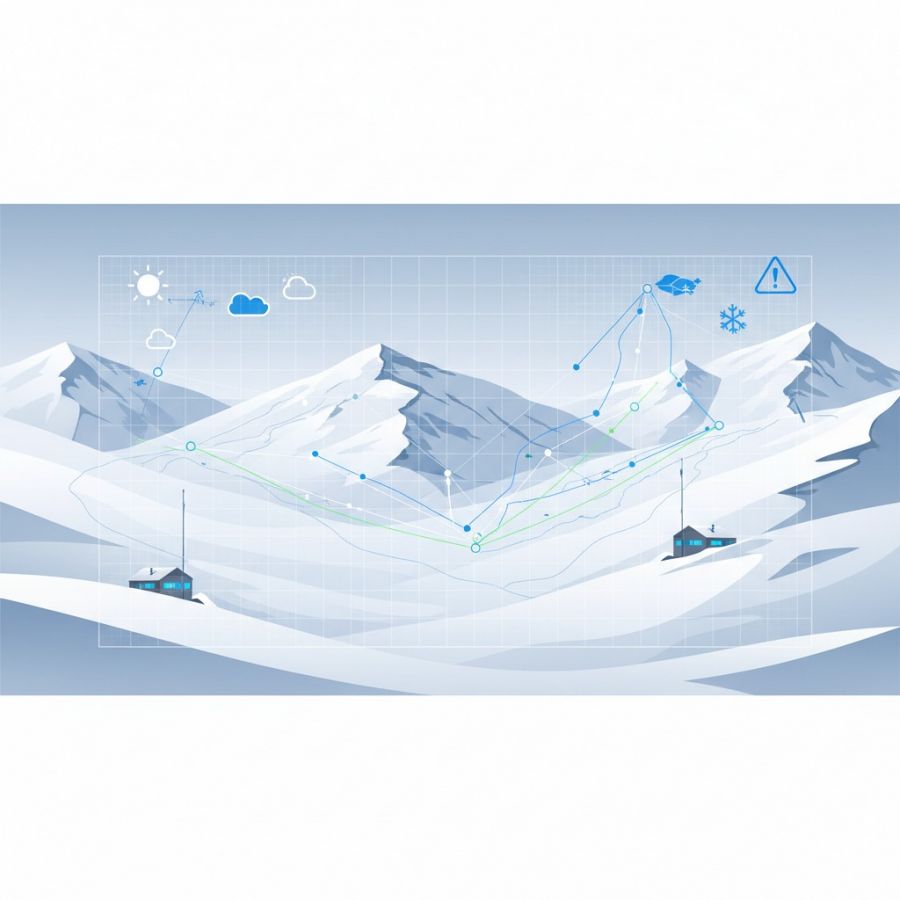
Mountain Planet: Mountains and Ski Areas - AI Reaches New HeightsArtificial intelligence is making its way into the world of mountain development. As it becomes more widespread and accessible (to local authorities, suppliers, professionals, and citizens), AI has entered the field of mountain planning in recent years, acting on several major fronts: optimization of infrastructure and traffic flows, improved safety and risk prevention, personalization of the tourist experience, sustainable resource management and ecological transition, as well as territorial modelling and planning. AI can provide a smarter, more sustainable, and more resilient vision of mountain development by improving infrastructure management, safety, customer experience, and environmental transition. It also encourages collaborative planning and innovation in mountain area management. From April 21 to 23, 2026, Mountain Planet will gather in Grenoble all global stakeholders involved in mountain development and soft mobility for an event that has become a showcase of innovations and achievements. On more than 60,000 m² of exhibition space, manufacturers, builders, territories, and operators will present the latest flagship projects from France and abroad, including new AI use cases to transform the tourist experience, optimize the operation of ski areas, and make the mountains even more connected, sustainable, and forward-looking. Slope Grooming and Snow Management There are already concrete and fully operational examples of AI being used to optimize ski slope grooming. The best-known is SNOWsat (by Kässbohrer, maker of PistenBully groomers), used in many European ski resorts. Algorithms guide the snow groomers along optimal routes, saving fuel and maintaining the best possible snow quality. GPS sensors mounted on groomers, combined with snow-depth sensors, send data to a platform that analyses snow depth, geolocation, terrain inclination and more in real time. The algorithm suggests the optimal grooming routes to avoid damaging low-snow areas, reduce unnecessary passes (saving fuel and CO₂), maintain consistent grooming quality, and reduce snowmaking where it is not required. In France, Switzerland, Austria and Germany, many ski areas use this system or similar ones (like LEITNER’s Skadii). North American resorts in Canada and the U.S. are adopting comparable systems (SnowGroomer, TechnoAlpin). Measured benefits include 15–20% fuel savings for groomers and up to 30% less artificial snow in some resorts, with 10% reduction reported in Laax. Values vary according to exposure, altitude, and snow conditions. TechnoAlpin has also developed ATASSpro, based on accurate weather forecasts, providing reliable predictions of the snow producible over the next seven days. Avalanche Forecasting AI now analyzes meteorological, topographical, and historical data to predict avalanche risks more accurately than traditional methods. It cross-references weather data (snow, wind, temperature, humidity), terrain data (slope angle, elevation, orientation), satellite or lidar imagery, and historical avalanche records. In Switzerland, the SLF (Federal Institute for Snow and Avalanche Research) developed in April 2024 AI models capable of predicting avalanche danger three days in advance with high reliability. In the U.S., the Colorado Avalanche Information Center (CAIC) uses machine-learning classification models to assign danger levels (1–5) to specific areas. AI could soon enable more frequent and more precise avalanche bulletins thanks to automation and rapid data processing. However, due to the complexity of weather phenomena and the impacts of climate change, AI cannot yet replace human expertise. Search and Rescue Assistance AI is increasingly used in search and rescue operations. Its advantages include rapid scanning of large areas, detection of victims invisible to the naked eye, reduced risk for rescuers, and optimized coordination through real-time sharing of precise GPS positions. In Europe, the Norwegian company AvalanchePRO (developed by ATLAS UAS) integrates an ARVA beacon sensor on drones (like AtlasPRO) to locate victims buried under avalanches. Tested by Norwegian People’s Aid, the system quickly and efficiently covers large areas. In Canada, North Shore Rescue uses drones equipped with thermal cameras and AI to identify heat sources in rugged terrain. In Romania, Vodafone is testing SARUAV, an AI system that analyzes real-time drone imagery to detect human shapes and clothing, transmitting coordinates to rescuers in minutes. AI-Assisted Ski Lift Systems The French company Bluecime has extensive experience with AI-based and computer-vision products for chairlifts and gondolas. Its intelligent computer-vision system SIVAO analyzes images in real time to detect open safety bars, risky behavior, overloaded cabins and more, triggering alerts or instructions. New AI-based Bluecime solutions are being deployed, such as queue analysis, and others—like full ski-area flow analysis—are under development. All Bluecime systems will be grouped under a global solution called SOFTEN, which uses AI to quantify skiers on slopes and in lift queues, model flows, and provide operational recommendations (including lift speeds), enabling up to 20% energy savings. For example, in the French ski area Les Sybelles, most chairlifts in Saint-Sorlin and Le Corbier are equipped with the SIVAO Chairlift system. This winter, the Côte du Bois gondola in La Toussuire will also be equipped with user-counting systems. The Swiss company Mantis Ropeway Technologies AG developed Mantis Autonomy, using cameras and AI to monitor passenger unloading and detect hazards, enabling unmanned operation at the lift’s top station (where regulations permit). After five years of development, the first operating permits were granted in December 2023, with six more systems rolled out during the 2024/25 winter. The system received the Swiss Mountain Award in October 2025. Predictive Maintenance AI is entering the field of predictive maintenance for cable transport—ropeways, gondolas, and related infrastructure—by monitoring equipment (cables, towers, cabins) to anticipate failures or wear before they become critical. Several manufacturers already offer this service. Doppelmayr developed AURO (Autonomous Ropeway Operation), a semi-automated system with sensors (cameras, vibration, temperature), allowing operation without an onboard attendant. Predictive maintenance is integrated through continuous data analysis. AI is also used for cable inspection: FATZER and LETSCAN are developing TRUscan.deep, an automated magnetic-inductive rope inspection system that detects even minor surface damage. Leitner analyzes sensor data to identify early signs of fatigue in cables, bearings, or motors, triggering targeted interventions instead of non-specific periodic inspections. POMA’s mountain ropeways renovation program integrates embedded sensors and advanced monitoring to enhance system availability and reduce maintenance costs. In New Zealand, NZSki uses advanced monitoring technologies for ropeways, enabling rapid incident detection and predictive maintenance, which reduces energy and resource waste and limits downtime. Engineering Processes for Cable Transport, Snowmaking, Mountain Safety and Adventure Infrastructure Beginning in 2026, the French group MND will integrate AI into its engineering processes, marking a new step toward performance and reliability in solutions for mountain mobility and outdoor infrastructure. By leveraging data and optimization algorithms, teams can design more energy-efficient systems more quickly, better adapted to local constraints. AI enhances every development stage: equipment sizing, real-world behavior simulation, predictive maintenance, and continuous improvement. This approach shortens design cycles, secures technical decisions, and makes delivery schedules more reliable. Other manufacturers will also integrate AI into engineering processes to create more efficient, sustainable, and climate-aligned mountain projects. Real-Time Monitoring Real-time monitoring of mountain slopes with AI opens new horizons for mountain safety, as early detection of debris flows is crucial for protecting lives, landscapes, and infrastructure. By combining high-resolution satellite imagery with ground-based cameras and sensors, algorithms automatically detect micro-movements, emerging glacier crevasses, or forming rockfall channels—often long before they are visible to the naked eye. These systems differentiate between slow evolutions (gradual slope deformation) and fast events (serac collapse, sudden landslides), allowing adaptive alert thresholds and evacuation scenarios. Already deployed in Switzerland, Norway, and other ranges, these tools greatly enhance anticipation capabilities for ski area managers, municipalities, and infrastructure operators. Research projects (ETH Zurich, WSL, etc.) use seismic sensors with AI and machine learning to detect debris flows and torrential avalanches earlier in alpine regions. Biodiversity Monitoring: AI Supporting Wildlife and Flora Tools that may be suitable for ski areas include DeepFaune, a collaborative, free French software that has become a reference for wildlife monitoring. DeepFaune automatically identifies animal species on images from camera traps installed in natural environments. In mountain regions, these cameras generate around 150,000 images per year in the Alps, processed by AI to identify ungulates (boar, deer, etc.). DeepFaune uses cutting-edge AI algorithms trained by research teams at CNRS joint research units at the Universities of Grenoble Alpes, Savoie Mont-Blanc, Lyon, and Montpellier. Its development relies on a collaborative science approach with more than 60 partners—national parks, associations, conservation groups, hunting federations, private citizens—providing millions of annotated images essential to training the models. In mountain environments, AI-assisted smart cameras can automatically process tens of thousands of images per year in minutes, reaching over 97% detection accuracy (DeepFaune) and drastically reducing manual sorting time. A ski area installing strategically placed camera traps could use DeepFaune to generate seasonal inventories (summer/winter), track annual variations, and continuously produce biodiversity indicators. About Mountain Planet Founded in 1974 in Grenoble (France), MOUNTAIN PLANET is the world’s leading trade fair for mountain development and industry, held at ALPEXPO, Grenoble’s event center in the Auvergne-Rhône-Alpes region. As an international gathering for mountain planning, it showcases the latest innovations and market trends. Every two years, this major event brings together the entire global mountain ecosystem (manufacturers, elected officials, local authorities, accommodation providers, ski-area operators, etc.). More than 900 exhibitors and brands from over 68 countries participate, with 60,000 m² of exhibition space and over 20,000 professional visitors. The 2026 edition will be held from April 21 to 23, 2026 at Grenoble-ALPEXPO (France). |
|

ropeways.net | Home | Economy | 2025-12-29
 Back
Back Add Photos
 Print
PrintMore articles:
Vail Resorts Unveils New Era of Colorado Mountain Dining
2026-01-02
Report: Idaho ski areas welcome 2M visitors annually
2026-01-01
Sunkid: Interactive "toboggan run" from Sunkid in the Upper Valais (Switzerland)
2025-12-31
Google Adsense