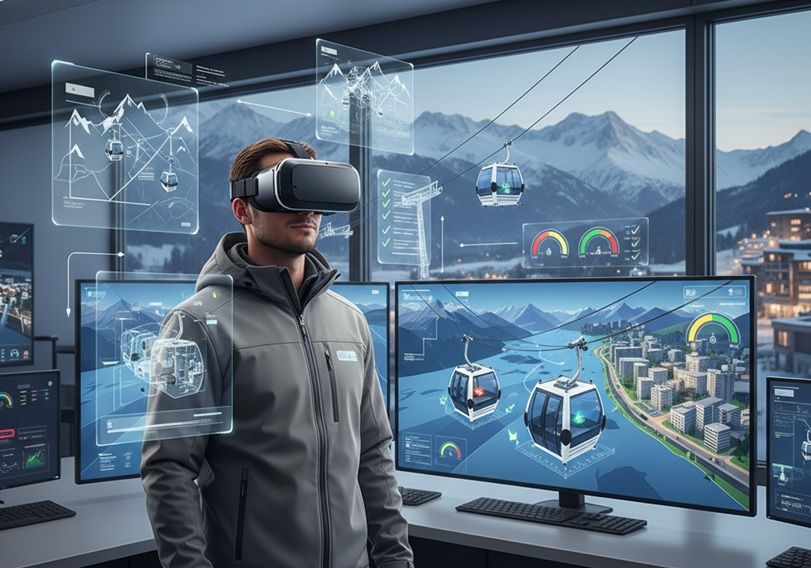
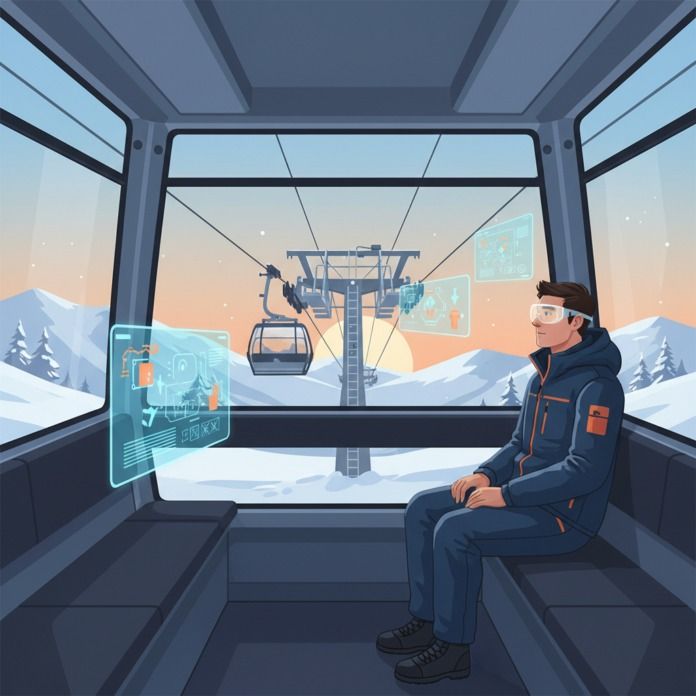
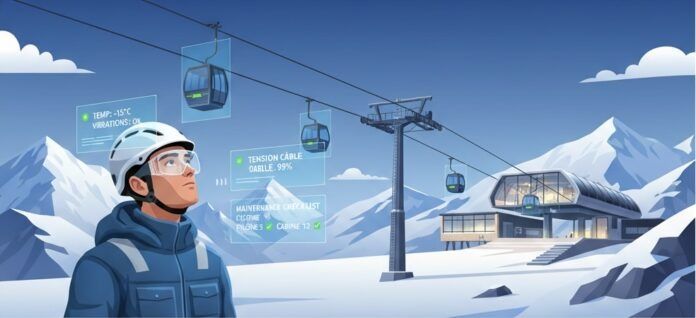
Mountain Plant: Cable Transport - Immersive Technologies Open a New Era for Training and MaintenanceImmersive technologies are increasingly establishing themselves as genuine working tools for training, maintenance, and ultimately predictive maintenance in cable transport systems. Virtual reality headsets, augmented reality solutions, and digital twins are ushering cable transport into a new era, where field expertise combines with the power of immersive digital technologies. The Mountain Planet trade show highlights these advances in cable transport, both in mountain environments for ski resorts and in urban and tourist settings. Training Teams with Virtual and Augmented Reality in Near-Real Conditions Immersive technologies now enable cableway personnel to be trained under near-real conditions, without risk. Virtual reality (VR) allows interactive simulation of operational, safety, and maintenance scenarios. In 2023, the Valloire resort in Savoie equipped itself with an immersive training simulator developed by IESA. This VR simulator reproduces the operation of different types of installations (chairlifts, gondolas, drag lifts) and enables trainee operators to practice operating procedures, customer interaction at stations, workplace safety rules, and the management of technical incidents—all within a realistic 3D environment. Raising Awareness of Eco-Driving and Energy Performance Another application is training in eco-driving for cable transport systems. Resorts are continuously reducing their energy footprint. A VR training module has been designed to make operators aware of how speed settings affect electricity consumption. Wearing a VR headset, the virtual operator sees the queue length and energy consumption of the installation in real time. They can then adjust operating speed according to passenger flow, optimizing overall energy use. Standardizing Training Through Augmented Reality Augmented reality (AR) enriches on-site training by overlaying diagrams or instructions directly onto equipment via tablets or smart glasses, guiding technicians through maintenance procedures or safety checks. An operator wearing AR glasses sees precise contextual information—such as component names, sensor locations, or step-by-step instructions—superimposed on the real environment. VR and AR make it possible to standardize training across multiple sites. Whether through immersive VR simulators or AR assistance tools in the field, immersive technologies are transforming workforce skills development while improving safety, energy efficiency, and technical mastery. Predictive Maintenance: From Data to the Field In cableway maintenance, the digital revolution is driven by IoT sensors, real-time data analytics, and increasingly immersive interfaces to support technicians. Augmented reality is proving particularly valuable for predictive maintenance and remote assistance by delivering the right information at the right place and time. Remote Assistance: The Leitner Example One concrete use case is the adoption of AR remote support solutions by major manufacturers. Industrial group Leitner relies on the TeamViewer Assist AR application (formerly TeamViewer Pilot) to provide real-time remote assistance to operating clients. Customer service experts view the site through the technician’s smartphone or tablet and annotate the live image to guide their actions. This enables many incidents to be resolved remotely, reduces specialist travel, and optimizes system uptime. The result: faster restoration of operations, fewer service interruptions for passengers, and significant cost savings. The entire sector acknowledges that immersive remote maintenance improves responsiveness and safety compliance. Visualizing Critical Data in Augmented Reality AR also supports predictive maintenance by displaying sensor data directly on real equipment. Using AR glasses, maintenance staff can see information such as motor temperature, pulley vibration levels, or cable tension overlaid on the machinery in real time. A quick AR glance can reveal when a component reaches a critical threshold or when misalignment occurs along a pylon line. Seeing live data makes it possible to anticipate failures rather than react to them, reducing unplanned downtime and increasing safety through immediate visual alerts whenever parameters move outside normal ranges. Checklists, Maintenance History, and Guided Procedures AR further facilitates access to checklists and maintenance histories: by pointing a tablet at a chairlift grip, a technician could instantly display its latest regulatory inspection or a 3D guide showing how to disassemble it step by step. Technical gestures are thus guided and secured. Companies such as Poma and Doppelmayr are integrating advanced digital solutions (remote diagnostics, hypervision, etc.), paving the way for immersive maintenance applications. Immersive Simulation and Digital Twins Immersive simulation also plays a role in maintenance. The same VR simulators used for training allow technicians to virtually test repair procedures or rehearse rare failure scenarios. A technician can practice replacing components at height or evacuating stranded cabins in VR, refining safety protocols and real-world responsiveness. Digital twins are also emerging: manufacturers can create a real-time 3D digital replica of a cable transport system, continuously updated by sensor data. Viewable in VR, this twin enables engineers to virtually inspect system conditions, detect structural anomalies (cable wear, pulley misalignment), and precisely plan preventive maintenance. Although still in early stages, these applications foreshadow a future where cableway networks are managed remotely from immersive control rooms using mixed reality. Toward Immersive Control Rooms Immersive technologies are gradually becoming standard in the cable transport sector for training and equipment maintenance. Public and private stakeholders—ski resorts, urban operators, manufacturers, and tech start-ups—are collaborating to deploy these innovations. Early feedback is promising: virtual and augmented reality enhance safety, efficiency, and creativity in a field where human expertise and technical reliability are essential. While these applications are still emerging, they point toward immersive control centers from which entire fleets of chairlifts and gondolas will be remotely operated, with real-time visibility of every installation. In this transition to Industry 4.0, century-old mechanical know-how is merging with immersive digital intelligence—for the benefit of operators, technical teams, and the public. About Mountain Planet MOUNTAIN PLANET is the world trade show for mountain development and alpine industry, held at ALPEXPO, Grenoble (Auvergne-Rhône-Alpes, France). An international meeting point for mountain professionals, it showcases the latest innovations and market trends. Taking place every two years, the event brings together the global mountain ecosystem (manufacturers, elected officials, local authorities, accommodation providers, ski area operators, etc.). Each edition welcomes over 900 international exhibitors and brands across 60,000 m² of exhibition space, along with more than 20,000 professional visitors from over 68 countries. The next MOUNTAIN PLANET exhibition will take place from 21 to 23 April 2026 at Grenoble-ALPEXPO (France). More information: http://mountain-planet.com/
|
|

ropeways.net | Home | Ropeways | 2026-02-16
 Back
Back Add Photos
 Print
PrintMore articles:
The new SmartCut tiller from PistenBully
2026-02-24
A tale of two regions - Colorado and Utah compared to the rest of the West
2026-02-23
Visit Big Sky Moves to DestiMetrics for More Reliable Destination Visitation Analytics
2026-02-20
Google Adsense