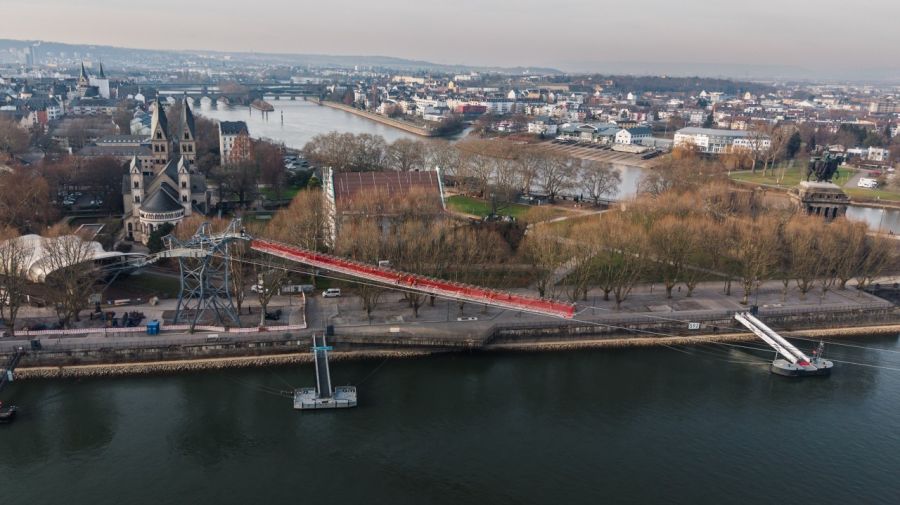
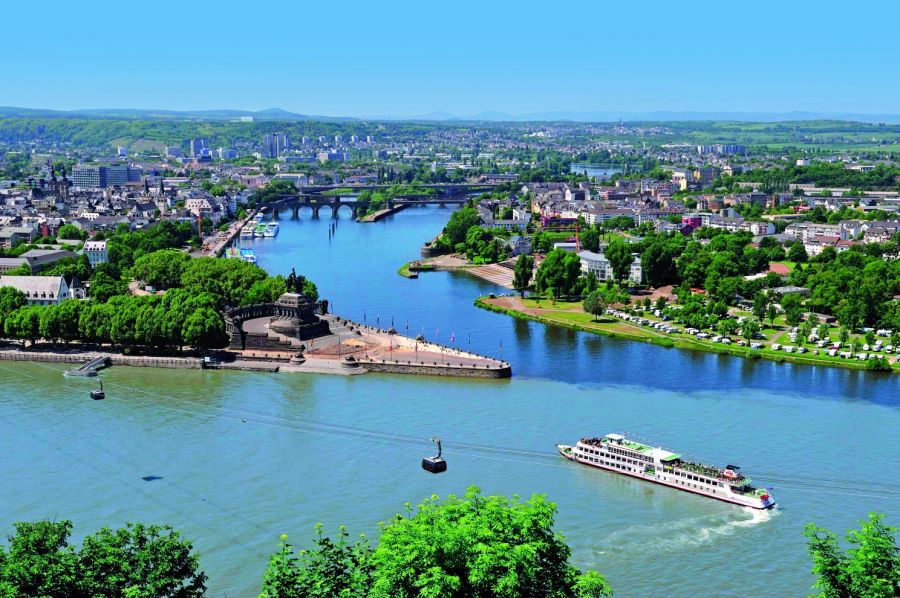
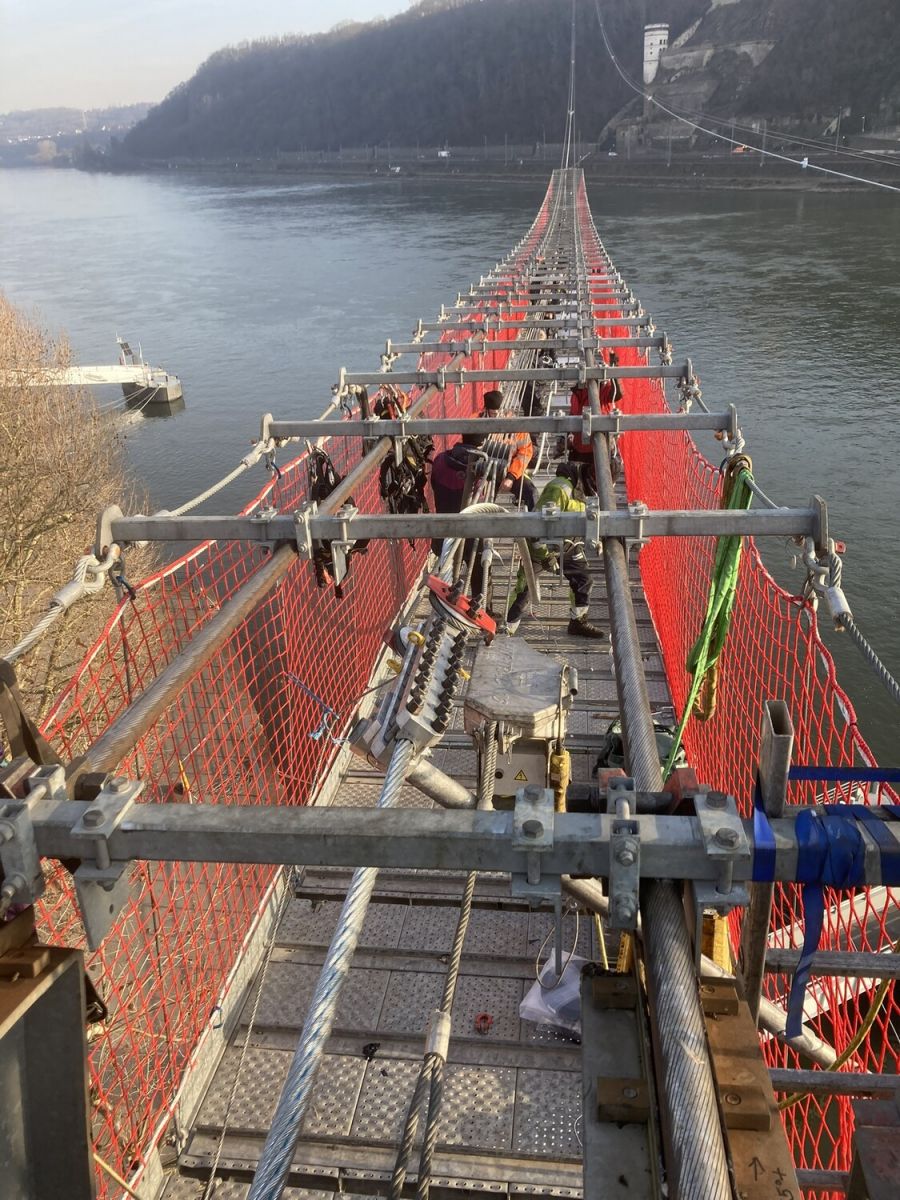
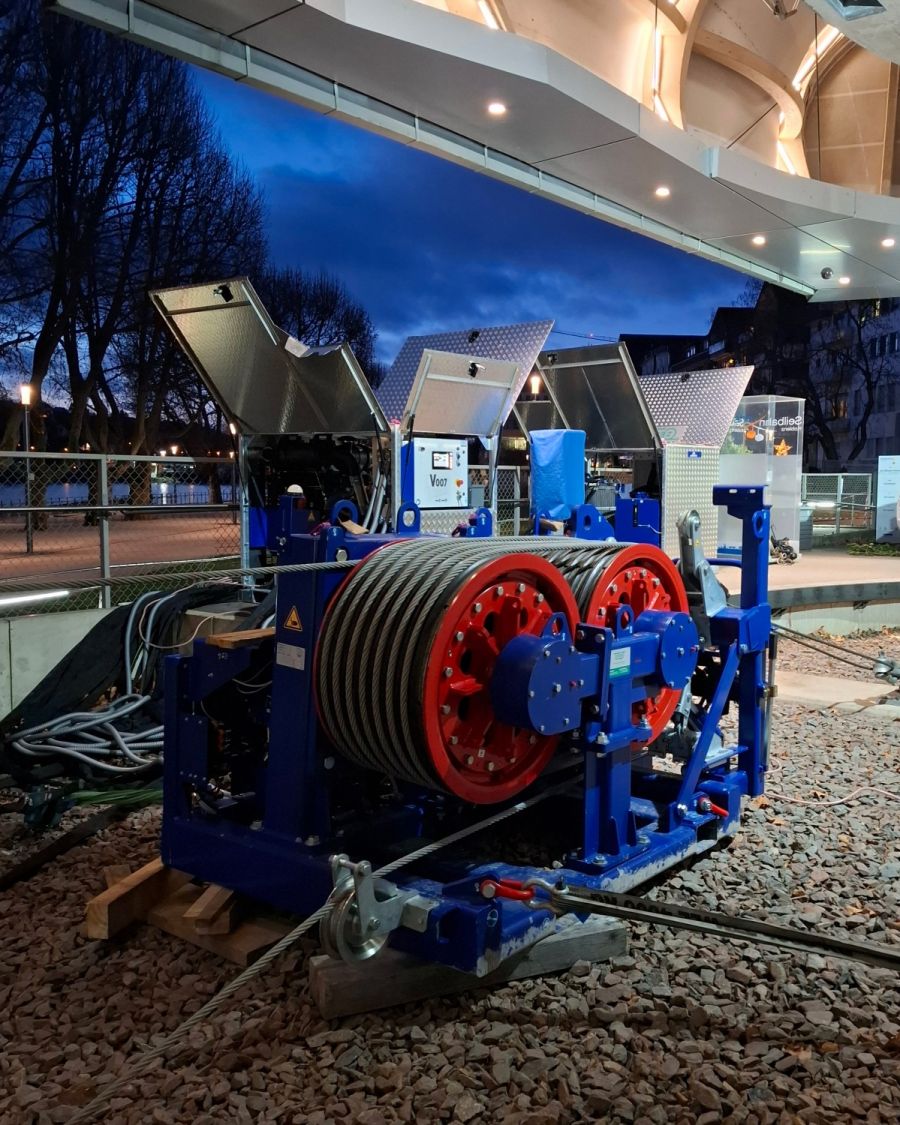
Garaventa: The importance of ropes in ropeway operationsAt the beginning of January, Garaventa commenced a comprehensive service contract for the Koblenz ropeway. The work included the scheduled relocation of the suspension ropes on both tracks and the first-ever replacement of the haul rope. A newly developed rope winch was used for this purpose. The Koblenz cable car is the Doppelmayr Group’s first 3S cable car in Germany and was built as an attraction and environmentally friendly transport link for the 2011 Federal Garden Show. Since June 2010, it has connected the Rhine gardens near St. Kastor’s Basilica with the plateau in front of Ehrenbreitstein Fortress. The system has 16 cabins and can transport up to 3,800 people per hour in each direction. The original plan was to dismantle the ropeway at the end of 2013. However, due to its popularity, it remained in place. The operating licence was extended in stages and is currently valid until 2030. Those responsible expect a further extension. The ropes are subject to particularly high demands to ensure that this ropeway operates reliably day after day. While the 54-millimetre-diameter suspension ropes carry the weight of the cabins and ensure the necessary stability, the 42-millimetre-thick haul rope moves the cabins at a steady pace around the route. The ropes are in use for around 2,700 operating hours per year. Such heavy use requires regular maintenance work. Safety is paramount The suspension ropes were moved according to plan without having to dismantle any intermediate suspensions. Carriageway 1 was moved 16.5 metres downhill and carriageway 2 was moved 19 metres downhill. The different displacement lengths were due to the fact that the station saddles of the two carriageways are not the same length. Each track was only moved as far as was technically necessary. During the entire moving process, the suspension ropes also had to be tested using magnetic induction. This ensured that any damage or changes inside the ropes were detected at an early stage. After the move, the intermediate suspensions were moved uphill by the corresponding length. This procedure redistributed wear and tear and relieved particularly heavily stressed areas of the rope. The suspension ropes were firmly tensioned at both stations and guided over bollards. The procedure had already proven itself and had been successfully used in Koblenz in 2015 and 2020. At the same time, the traction rope was replaced for the first time since commissioning. The 6-strand traction rope used previously had transported millions of passengers safely across the Rhine during its 16 years of service. Now, a new 8-strand traction rope has been installed, which offers smoother running and a longer service life thanks to its design. Although the safety of the previous traction rope would have continued to be guaranteed, this step was easy to implement because heavy equipment and tools were already being used for the suspension rope work. Unlike the first cable replacement in 2010, which was carried out using helicopters and ships, the old and new traction ropes were connected directly to each other today and pulled tight in a controlled manner. This was followed by splicing, i.e. intertwining the wire strands at both ends to create an endless connection. The customer had also commissioned additional maintenance work. This included new rubber inserts on the deflection pulleys in the mountain and valley stations. However, a special insert was required for the drive pulley in the mountain station, as this pulley transmits the adhesive force between the rope and the pulley. A rubber insert was unsuitable for this purpose, as it did not achieve the required coefficient of friction. Newly developed winch for confined spaces Garaventa used a newly developed ZECK winch for the rope work in Koblenz. The winch, developed by Garaventa and manufacturer ZECK GmbH, is designed for work in confined and difficult-to-access areas. The winch is significantly lighter than previous models and can be dismantled into individual modules. This makes it easier to transport and ship, even for use on other continents. The winch is designed to pull and brake ropes without twisting. Tractive and braking forces of up to 15 tons are possible. The winch was used for the second time in Koblenz. It had previously been used for the cable pull of the second Birg–Schilthorn line of the Schilthornbahn 20XX project, where it proved its strengths and was then further optimized for use in Koblenz. The cable car runs over a busy road, a railway line, and crosses the Rhine, over which ship and freight traffic runs continuously and cannot be interrupted. During the work, the ropes therefore had to be kept at a safe height at all times so that neither road and rail traffic nor shipping traffic was affected. All work steps were planned and carried out in such a way that these transport routes remained open. The work proceeded according to plan, so that the Koblenz cable car will be able to resume operation on March 14, 2026.
|
|

ropeways.net | Home | Urban | 2026-02-26

 Back
Back Add Photos
 Print
PrintMore articles:
Kyrgyz Republic: OJSC Ala-Too Resort Signed New Contract with Doppelmayr
2026-03-05
Indy announces sixteen new Resorts 26/27. Flagship Indy+ Pass price lowered.
2026-03-04
Google Adsense